


In the lobby of the Four Seasons Hotel Gresham Palace Budapest, a 1906 Art Nouveau structure that somehow became a hotel in one of Central Europe’s more dramatic city squares, with a view of the Danube and the Széchenyi Chain Bridge, there is a quality of attention that is hard to pinpoint but instantly identifiable. Instead of waiting to be asked, the staff moves around the room as though they know what will be needed in the coming minutes. The bar’s espresso comes with an unrequested detail about the beans and a tiny square of dark chocolate.
Instead of directing someone to the concierge desk, a question concerning restaurant reservations in other parts of Budapest results in a sincere recommendation. These are minor issues. They also place Four Seasons at the top of the World’s 50 Best Hotels, receive more Forbes Five-Star ratings than any other company for the ninth straight year, and get a hotel listed in the Travel + Leisure T+L 500 for the May 2026 issue.
In just the Travel + Leisure World’s Best Awards in 2025, 45 Four Seasons resorts took home a total of 49 honors. Three establishments, the Chao Phraya River hotel in Bangkok at number two, the Firenze at number nine, and the Astir Palace Athens at number seventeen, were ranked in the top twenty of the World’s 50 Best Hotels. Four restaurants, 17 spas, and 44 hotels and resorts make up the Forbes Five-Star rating of 65. It’s important to note the final category: Four Seasons restaurants’ Five-Star accolades are not incidental to the hotel industry.
SÉZANNE and VIRT� in Tokyo, BKK Social Club in Bangkok, and Il Palagio at the Firenze are all dining destinations in and of themselves, so the establishments are creating attractions outside of the rooms. Marriott’s Ritz-Carlton collection and the Waldorf Astoria portfolio can not yet fully match the advantage of having restaurants and bars that belong on world-ranking lists for a brand that competes in a market where distinction is crucial.
When Isadore Sharp opened the first Four Seasons in Toronto in 1961, he developed a service philosophy that is commonly referred to as “The Golden Rule”—treat guests as you would like to be treated yourself. This may sound more like a catchphrase than a functional system until you look at what it actually produces. The Golden Rule framework is meant to be self-referential rather than prescriptive. It instructs employees to use their own judgment on what they would find excellent and then carry that out rather than giving them precise instructions on what to do in every circumstance.
Instead of being trained to follow a checklist, this results in a workforce that is trained to observe and react. The hotels that consistently pass Forbes Five-Star inspections are those whose standard-meeting conduct is habitual rather than driven by inspection fear. Forbes Five-Star inspections comprise anonymous visits against over 900 precise standards. About fifteen minutes after arrival, the difference between the two things becomes apparent.
The Four Seasons model’s hyper-local component is what most obviously sets it apart from the established worldwide hotel brands that relied on constant consistency to establish their names. For thirty years, the Ritz-Carlton standardization model—same pillows, identical minibar, identical service script—was the prevailing luxury hotel concept that resulted in genuinely dependable experiences. However, it also created a kind of worldwide uniformity that luxury travelers have learned to identify and, in some situations, consciously avoid.
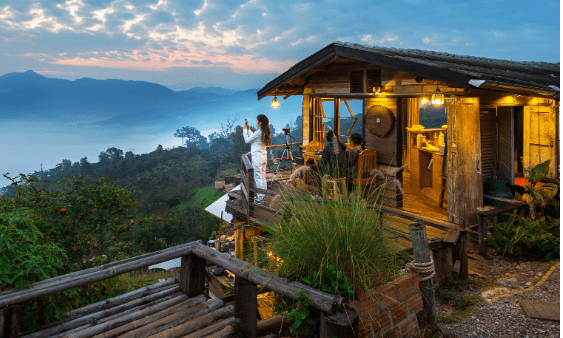
The Wara Cheewa Spa offers traditional Thai therapy, Four Seasons has taken the other approach, offering culinary lessons that teach northern Thai cuisine instead of generic “Asian-inspired” cuisines, and rice terrace lodgings in Chiang Mai that take part in actual rice growing cycles. Located on the Athenian Riviera, the Four Seasons Astir Palace Athens is more of a truly Mediterranean experience than an international hotel that just so happens to be in Greece.
The Grand-Hôtel du Cap-Ferrat’s air-conditioned glass cliff lift is an example of the kind of specific, tangible luxury that results from actually understanding a property’s friction points rather than using a general renovation checklist. It solves the particular practical problem of getting from a clifftop hotel to a sea-level beach without the physical effort that most properties simply leave guests to manage.
Perhaps underestimated as a contributing element to the brand’s long-term success is Four Seasons’ private ownership structure, which is mostly controlled by Prince Alwaleed bin Talal’s Kingdom Holding and Bill Gates’ Cascade Investment. Quarterly earnings pressure on publicly traded hotel corporations often leads to service personnel reductions, maintenance postponements, and other little cost savings that, while seemingly insignificant on their own, undermine the experience that customers are paying for.
There are no quarterly earnings calls for Four Seasons. Its investors, who have very long time horizons, have built the business on the idea that service quality is the revenue model rather than a cost that needs to be managed. As the award results pile up year after year, it’s difficult to ignore the fact that this trend represents not only operational execution but also a company structure that was created to safeguard the circumstances that allow for quality service.
