


These days, it’s not the distant sound of a coaster lift hill or the aroma of churros that greets you as you approach SeaWorld San Diego. It’s the silence. particularly after dark. For years, fireworks dominated the summer skies over Mission Bay, causing elegant terns to scatter in what bird watchers later described as panic flights with a certain grim precision. The show is now silent most nights. The bay below remains motionless as six hundred drones take off, choreographed into constellations, rays, and orcas.
It’s odd to see, in part because no one anticipated SeaWorld would give in. For the better part of ten years, the company has been subjected to criticism similar to how a sponge absorbs water—slowly, reluctantly, and only when completely saturated. For years, the fireworks dispute had been simmering. The pivotal moment appeared to be the San Diego Audubon Society’s 2024 letter to the California Coastal Commission, which included images of dead birds and chemical residue floating in the bay. There were then legal threats. The displays vanished almost immediately after that.
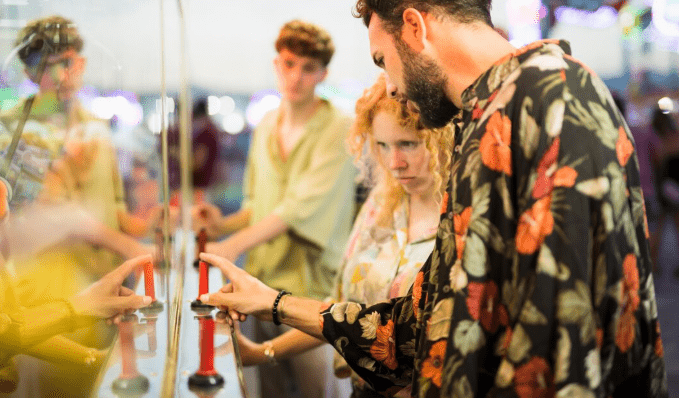
There seems to be more going on in SeaWorld’s parks than just one evening performance. The Jellyfish Experience in San Diego, the Immersive Experience in Orlando, and the Rescue Jr. zone in San Antonio are among the 2025 attractions that heavily emphasize indoor, climate-controlled, animal-adjacent storytelling. It makes sense in ways that go beyond marketing. Even longtime residents acknowledge that the harshness of Florida summers is a recent development. The afternoon thunderstorms continue to arrive on time. The heat no longer breaks as it once did.
CEO Marc Swanson has been discussing international expansion, hotels, strategic growth, and the typical investor-call jargon for some time. However, there’s more intriguing going on beneath the words. At last, the company is creating parks that are appropriate for the environment and culture in which it operates, rather than the one it wishes still existed. Fireworks that spew plastic over a wildlife habitat would eventually deteriorate. And so were the lengthy lines outside in August in Florida. Whether SeaWorld can move quickly enough is the question.
The figures reveal a complex narrative. The number of visitors to the company’s parks has been declining for years, far below the peak of 25 million in 2008. Recently, there have been reports of an 84 percent decline in some sales categories; the company itself has cited ongoing brand issues. It’s a very effective phrase. It discusses Blackfish, orca disputes, maintenance grievances, and the perception among devoted fans that something important was lost in the process.
Walking through the parks now, however, gives the impression that the company is no longer struggling with its own reality. The transition to sustainable seafood, cage-free eggs, and crate-free pork are not revolutionary announcements in the sense that a press release might present them. These are catch-up actions. These adjustments were made years ago by the majority of chain restaurants. However, they convey something more significant to SeaWorld: a readiness to put an end to conflict.
The practical effects are beginning to manifest in minor ways for visitors. shorter wait times outside for some rides. Instead of being marketed as filler, more indoor exhibits are being promoted as headline experiences. a show at night that doesn’t leave trash in the water the following morning. These are not the kinds of modifications that result in eye-catching magazine covers. They are the ones that eventually alter the true experience of a day at the park.
Whether any of this will be sufficient to bring back lapsed visitors is still up in the air. SeaWorld’s identity has been shaky for so long that some visitors are unsure of what the park is anymore, and the competition in Orlando alone is fierce. However, it appears that the company is posing that question for the first time in a long time.
