
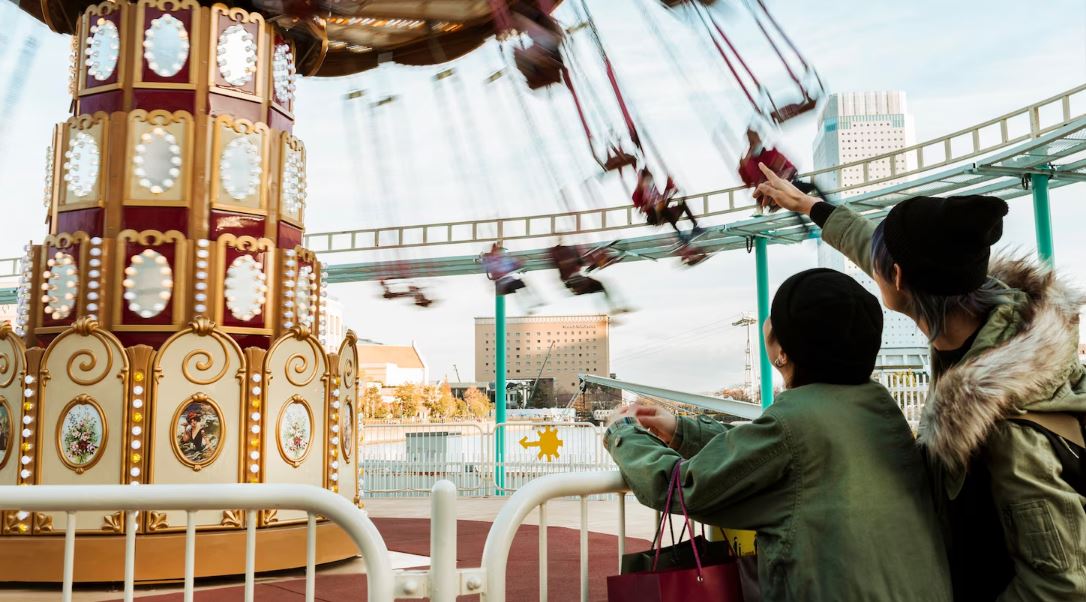
A specific type of summertime ritual in America entails standing in a line, perspiring a little, and having faith that the machine that is going to throw you upside down has been inspected by a qualified individual. The majority of people never inquire about that person’s identity. It is worthwhile to inquire.
The Consumer Product Safety Commission was the solution for nearly ten years, from 1972 to 1981. Then it wasn’t. Congress completely removed “fixed-site” amusement parks from federal jurisdiction after two Texas lawsuits, a divided ruling by judges, and a quiet legislative remedy. Traveling carnivals continued to be controlled. The permanent parks, the ones with shareholders and corporate headquarters, didn’t.
It’s difficult to ignore how practical that distinction proved to be. The industry hasn’t merely put up with that disparity in the years since. It has been defended. The International Association of Amusement Parks and Attractions has put a lot of effort into arguing that since injuries are uncommon by its own standards, federal oversight would be pointless, costly, and redundant. An industry publication was once informed by a former IAAPA executive that a federal agency would cost taxpayers millions of dollars for a problem that hardly exists. When you’re the one providing the injury statistics, it’s easy to make that claim.
The end result is a patchwork that is largely dependent on geography. There are about twenty states that have comprehensive oversight. Nine have none at all, but the majority of those states don’t have many fixed parks in the first place, so the lack of parks feels more like a lack of concern than an oversight gap. In other places, the approval of a roller coaster’s restraints comes from a state fire marshal or, occasionally, an agriculture official. Even though it has been true for more than 40 years, it still feels weird to write.
Florida adds to the complexity. With the exception of a carve-out that exempts parks with more than 1,000 employees from state inspection requirements, the state’s regulatory framework is thought to be rather robust. Disney World, Universal Orlando, and Busch Gardens are essentially covered by this exemption, so the biggest and most popular theme parks in the nation are allowed to conduct their own inspections. That’s almost too neat. The largest players receive the least amount of attention.
Until something goes wrong, none of this usually comes to light. Settlements with impacted families are common, quiet, and often subject to confidentiality agreements. Criminal prosecution is so uncommon that it is noteworthy. One of the few cases in which owners were charged with murder resulted from the 2016 death of ten-year-old Caleb Schwab on a Kansas water slide; the charges were eventually dropped by a judge.
Another noteworthy aspect of Disney’s recent standoff with Florida lawmakers—which started over the so-called “Don’t Say Gay” law and ended with the state dissolving and reconstituting Disney’s special governing district—was how intertwined these corporations are with the very governments that are supposed to be in charge of them. The question of who answers to whom quickly becomes hazy when a theme park operator can also operate as something close to its own municipality.
It would be simple to present this as a tale of corporate greed at the expense of safety, but that would probably be overly simplistic. By most measures, injury rates are actually quite low in comparison to attendance; in a single pre-pandemic year, there were 1,294 ride-related incidents across all surveyed parks, compared to over 159 million visits to the top venues alone. There is no hidden epidemic being concealed by the lobbying. It’s defending a status quo that just so happens to be very beneficial to those who uphold it.
The industry doesn’t seem particularly eager to have the question of whether the status quo benefits the riders waiting in line addressed.
