


Anyone who has lived in Metro Vancouver for a month may relate to the unique nature of the issue. At sea level, it seldom snows and the temperatures remain moderate, so it’s not frigid in the sense that it stops everything. It produces rain. constantly, persistently, sometimes without pausing for days. For weeks at a time, the stunning mountains are hidden behind clouds. The trails, parks, and beaches—the outdoor attractions that characterize British Columbia’s summer tourism—become either unreachable or extremely unpleasant. Additionally, families with kids who are confined indoors without organized entertainment turn into an underserved market that is waiting for someone to create something.
In contrast to previous incarnations of the province’s indoor entertainment drive, that building is currently taking place with a renewed intensity. With 175,000 square feet, Central City Fun Park in Surrey is the biggest indoor amusement park in British Columbia. All year long, a sizable arcade, go-karting, mini-golf, and roller skating are all together under one roof. In the American Midwest, where harsh winters have fueled indoor entertainment infrastructure for decades, such a venue would be commonplace. It closes a gap that outdoor-oriented tourism promotion in British Columbia has been silently ignoring.
Abbotsford’s Castle Fun Park encompasses a variety of demographic and geographic areas. East of Vancouver, the Fraser Valley attracts a mix of rural tourists and suburban families who don’t often travel to the city for entertainment. More than 200 arcade games, go-karts, batting cages, and several mini-golf courses can be found at Castle Fun Park. It has been in business long enough to maintain a consistent foundation, which is important in this market. Indoor entertainment venues require foot traffic on a weekly basis, not just during school breaks. A facility that already has a local audience has a structural advantage over one that is attempting to create one from the ground up.
A contrasting paradigm is represented by Tsawwassen Mills, a sizable shopping and entertainment complex located close to the ferry ports south of Vancouver. FlyO’Land, with its trampolines, rock climbing walls, and ball pits for younger children, is located inside a retail setting that also attracts families spending the day rather than just a few hours. The mall has been adding specialized play spaces instead of developing separate facilities. With the decline of traditional anchor tenants, mall operators throughout North America have been pushing toward this layered economic model: entertainment driving retail dwell time, retail subsidizing entertainment infrastructure.
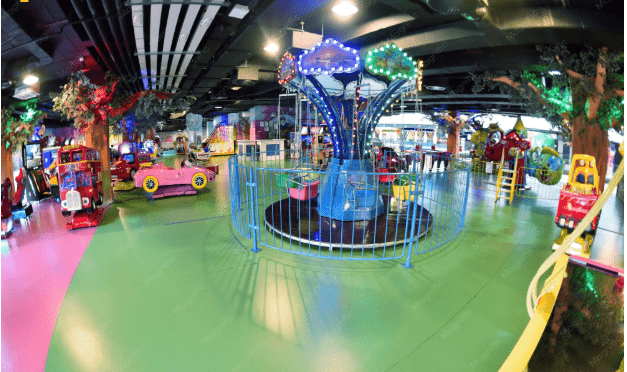
All of this has a fairly straightforward weather logic, but it’s important to understand the economics. If the seasons cooperate, an outdoor theme park in British Columbia can make money for about five or six months of the year. Every day an indoor facility is open, it generates income, which significantly alters the investment’s unit economics. A longer revenue window offsets higher construction costs, which are higher per square foot for climate-controlled space than for open-air infrastructure. Operators are willing to commit the capital because of that calculation.
