


A roller coaster that shouldn’t exist in its current condition can be found in Wisconsin Dells, tucked away among the waterparks, go-kart tracks, and cheese stores that line the main strip of what occasionally advertises itself as the Waterpark Capital of the World. From most perspectives, Hades 360, which is located at Mt. Olympus Water & Theme Park, resembles the other massive wooden coasters that devotees have been riding since the early 20th century. It features stacked timber, a white lattice frame, and the well-known rhythm of chain lift and gravity. The train then descends into a 1,400-foot underground tunnel beneath the parking lot, roars back up into daylight, and travels entirely upside down on a wood-only track.
That is something that no other wooden roller coaster in the world does. Many have attempted, in different ways, to send riders thru an inversion; however, all of these attempts have used steel as the main structural element of the track thru the inversion zone, which is a significant difference from what The Gravity Group accomplished at Wisconsin Dells. The track for the Hades 360 corkscrew is entirely made of wood. Rather than the running surface, the steel is in the support framework. This particular coaster is truly unique due to its engineering distinction, and what makes it intriguing is realizing why it needed to solve a problem that had seemed unsolvable for decades.
Geometry and material behavior present a difficulty for wooden coasters performing tight inversions. Multiple laminations of wood that have been bent to shape and stacked together make up traditional wooden roller coaster track. This method permits moderate curves and even some overbanking, but it resists the tight, twisting geometry of a corkscrew. The goal of the track is to remain mostly straight. The laminations like to bounce back as you force it thru a 360-degree roll, which causes tension at every twist and speeds up wear. Conventional wooden coaster trains’ wheel assemblies, on the other hand, are made to withstand the expected range of forces on ordinary wooden track geometry and cannot handle the quick change in lateral direction that an inversion necessitates without fighting the track at every point of contact.
The second portion of the issue was resolved by Gravitykraft Corporation’s Timberliner train system, which was specifically created in relation to Gravity Group’s work on this type of ride. On a single-axle bogie, each row of seats in a Timberliner train rotates individually. Instead of moving thru the track as a rigid unit, the train articulates, with each car following the track geometry independently rather than being dragged thru it by the car in front or behind.
Because the train is adapting to the contour rather than resisting it, this lessens the lateral forces that any particular piece of track must withstand. When Hades 360 debuted, Chad Miller of The Gravity Group explained it simply: the ride needed both the Timberliner trains and the new computer modeling capabilities. The inversion’s track geometry would not have been rideable without the trains. The trains couldn’t have helped if the track geometry hadn’t been exactly right.
The inversion is mechanically set up in the subterranean tunnel segment. The train accelerates thru about a quarter mile of enclosed darkness as it descends 140 feet into the tunnel at a 65-degree angle, which is steep enough that the downhill angle alone is exceptional for a wooden coaster. The sensory confusion is increased by a 90-degree banked curve in the dark. The train then meets the corkscrew as it emerges into daylight, still maintaining the speed it had accrued underground. The train must arrive at the inversion with enough speed to reach the apex without stalling, but not so much that the lateral forces during the twist exceed what the track laminations and wheel assemblies can safely withstand. This is how the roll’s physics work. When discussions about inverting a wooden coaster initially began in the 1990s, the computer modeling that Miller mentioned was necessary to get that window just right.
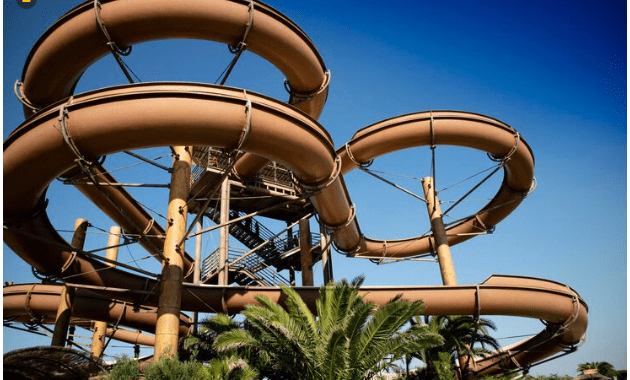
As might be expected for something this new, the outcome has caused division within the enthusiast community. Hades 360 is frequently characterized as a singular experience, powerful, and hard on the wooden parts. The inversion itself is seamless; riders describe it as a surprisingly controlled moment given what’s happening because of the Timberliner trains and the accuracy of the track geometry thru the corkscrew. The wooden coaster that comes before and after does what wooden coasters do, which is move with a lot less smoothness than steel. Reading ride ratings from the last ten years gives me the impression that people are unsure of how to rank something that is both an actual engineering first and a genuinely tough wooden coaster. The two cohabit. Neither eliminates the other.
