


A group of technical committee members are working on a document in a meeting room somewhere in England that most people will never see but whose conclusions will have an impact on every soft play center and bouncy castle in the nation. Anchoring calculations, fire retardancy statistics, entrapment geometry parameters, and wind loading test results on commercial inflatables of different sizes and configurations are all included in the papers on the table. It’s not a glamorous job. Additionally, it is quite significant for the families who utilize this equipment on weekends.
The Standards and Related Documents Committee of NAFLIC, the National Association for Leisure Industry Certification, is in charge of upholding and developing the technical framework that regulates indoor soft play equipment and commercial inflatables. NAFLIC is the organization that leads the inspection community for the UK’s amusement and leisure sector. This organization is not part of the government.
It is an industry-driven organization that creates standards that operators must adhere to by collaborating with the Health and Safety Executive and reputable inspection programs like PIPA and ADIPS. The distinction is important since NAFLIC’s authority is derived not from legislation but rather from industry recognition of its technical credibility. When the committee reevaluates something, it usually does so because something has changed that the current standards don’t adequately address, such as equipment design, operating procedures, or the findings of accident investigations.
The committee’s work is shaped by the unique and well-documented history of the inflatable industry. NAFLIC’s Technical Bulletin 313, which explicitly addresses wind loading and anchoring standards for inflatable structures, was created in response to the 2006 event at Chester-le-Street, County Durham, where a big inflatable art piece was lifted by wind and killed two persons. That bulletin pushed the industry to treat anchoring as an engineering problem with calculable solutions rather than a matter of operator judgment, and it established the principle that wind loading is frequently the dominant risk factor for large outdoor inflatables, not fabric failure or overloading.
This framework is incorporated into BS EN 14960, the main standard for commercial inflatables, which specifies how anchors should be positioned, at what angle, at what minimum holding force per anchor point, and how ballast weights should be used in place of ground stakes on hard surfaces.
The committee’s current activity reflects both the market’s progress and the particular discrepancy between approved equipment and compliant operation. The inflatable hire industry in the UK has experienced significant growth and comprises a diverse range of operators, from professionally run businesses with certified equipment, trained personnel, and documented safety procedures to unofficial operators who have purchased used equipment without documentation and are operating primarily outside of any recognized framework. The criteria themselves are not too complicated. The problem is that the equipment’s certification provides no information about how it is being used on a particular Saturday afternoon, and a large percentage of incidents are caused by operational failures, such as poor supervision, mixing the wrong age groups, or a slow reaction to shifting wind conditions.
A distinct set of technical difficulties is presented by the soft play industry. BS EN 1176 and BS EN 1177, which were initially created for outdoor playground equipment and modified for indoor commercial contexts, are the main regulations governing indoor soft play centers, which are those multilevel foam and PVC mazes that kids spend hours inside at leisure venues, shopping centers, and family entertainment centers. The geometry of openings and barriers that could trap a child’s limb or head, the structural integrity of multilevel framing, the impact absorption qualities of flooring surfaces, and the fire retardancy of the foam composites used throughout all need to be reviewed on a regular basis as materials change, installations get bigger and more complex, and real-world incidents show gaps in what the current specifications cover.
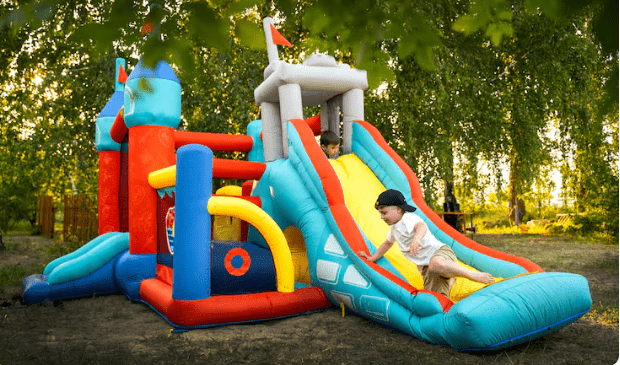
Due to recent events involving inflatable buildings, fire retardancy has gained special attention. The fire resistance requirements of BS 5852 must be met by PVC-coated foam composites used in indoor soft play. The committee is investigating whether periodic retesting of materials in use is required or if verification at the point of manufacture is adequate. Foam and PVC deteriorate over time, and fire performance that met specifications when the equipment was new may not be maintained after years of commercial use. This is not a straightforward regulatory query. It has significant financial ramifications for operators, especially smaller independent venues, and the industry is figuring out how to establish regulations that accurately reflect risk without placing restrictions on smaller operators that would force them out of the regulated market completely.
