


People sometimes have ideas that come too early and aren’t handled well. These ideas then become stories that people tell at planning meetings for years after the fact. The plan to build a huge theme park on the northern edges of Dublin, which is called Vega City, is a good example of one of these stories. It came up in public in 2003, but Fingal County Council turned it down in a big way that November. Since then, it has been brought up again and again in discussions about Irish tourism, sometimes as a footnote, sometimes as a cautionary tale, and sometimes as something worth going over again.
At the time, it was really hard to understand how big what was being proposed was. Louis Maguire junior, a developer, led a group that eventually included Owen O’Callaghan of O’Callaghan Properties, a well-known name in commercial development in Ireland. They wanted to build a €7 billion entertainment complex on a 2,500-acre site near Lusk in north County Dublin. This is bigger than Phoenix Park. It’s bigger than Disneyland Paris. It was supposed to have three separate theme parks, a safari park built around a big lake, 14 hotels, 10,000 apartments, a concert hall, an ice rink, a golf course, an equestrian center, and a monorail that would have gone back to the city 22 kilometers away. The consortium thought that 35 million people would visit each year, with 18 million coming from outside of Ireland.
There is flat farmland and small housing estates all around Lusk today, which is about 10 kilometers from Dublin Airport. It’s hard not to imagine what that landscape must have looked like. Or, to be more honest, if it would have worked at all.
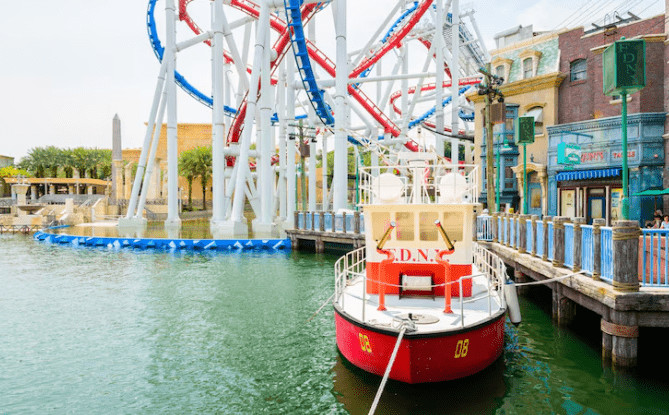
The meeting of the council that killed the plan wasn’t very close. 19 votes to 1 against supporting the project were cast by Fingal. William Soffe, the manager of the county, told the council that the plan was “ill-thought-out and lacked credibility.” Planning officials said that Vega City would have broken rules about development, caused a lot of traffic problems, and probably couldn’t make money in the long term. One director of planning said that the expected number of visitors would mean that Dublin Airport would have to handle 60 million passengers a year, which was more than Heathrow’s at the time. When you think about that observation again, it tends to hit you hard.
The consortium wasn’t presenting a fully completed planning application, so let’s be fair. O’Callaghan made it clear that the meeting in November was just a first conversation to see if the council would be willing to work with them before they spent the estimated €10 million needed to file a full planning application. The way the presentation was framed might have made it seem less clear than it really was. It looks like councillors were hoping for more substance. For most of them, what they got felt like an idea that was waiting to be made real.
Maguire’s reaction to the vote showed that he was deeply upset. “Look at what Disneyland did for Orlando,” he said back then, “with well-paid jobs, a lovely environment and making kids and people smile.” It seems like he really believed in the idea, even though it wasn’t working out perfectly. For his part, O’Callaghan said he was moving the project out of Ireland and maybe even to Britain. He also said that the site near Dublin was the best place in the country for that kind of project.
Since then, Ireland hasn’t even come close to building something like it. In the 20 years since that council meeting, the country’s tourism infrastructure has grown a lot. The number of visitors steadily rose before the pandemic and then recovered afterward. But the question of a big, must-see entertainment complex—the kind of center attraction that brings families from all over Europe for a week, not just an afternoon—has never been really answered. The city around Dublin Bay has changed a lot, but Dublin Bay itself is still a beautiful natural area that is protected by UNESCO as a Biosphere Reserve. It’s still not clear if that makes room for a risky tourism idea or if the Vega City experience just proved that Ireland isn’t the right place for it.
What the episode really leaves us with is a question about hunger. Not just political will, though that is important, but also the public’s ability to imagine something big happening on the edge of a small capital city. Even though the 2003 plan wasn’t well thought out and came at the wrong time, the idea that Ireland could support something bigger than what it has never really went away.
