


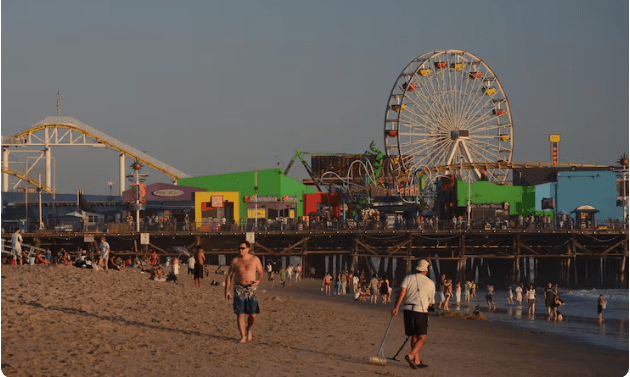
There is currently a gap where 600 Boardwalk meets the Atlantic at the north end of the Ocean City boardwalk. That location was home to Gillian’s Wonderland Pier for 94 years, long enough for several generations of families from Philadelphia and South Jersey to create summertime memories there. From the ocean, the Ferris wheel was visible. The mechanical songs of the Monkey Band were performed. Twenty years later, children who had gone on the rides when they were six years old returned with their own children. Then it closed in late 2024. And now Ocean City is attempting to make judgments about what will happen next in a way that is generating the kind of community discourse that property decisions in cherished resort towns always eventually produce.
In June 2026, the Ocean City Council voted 5-2 to officially designate the 600 Boardwalk property as a “Area in Need of Rehabilitation” under New Jersey redevelopment law. This designation enables the municipality to collaborate with property owners on development plans that might otherwise be subject to more stringent zoning. Eustace Mita, the proprietor of Icona Resorts, a brand of upscale hotels with properties along the Jersey Shore, owns the property. Mita has proposed a 252-room hotel, a noteworthy building on one of the most prominent corners of the boardwalk, with certain architectural features that might allude to the location’s amusement past.
The community discussion becomes complex when it comes to the 252-room proposal. Among New Jersey coastal communities, Ocean City stands out for being a dry, family-focused community devoid of the late-night economy that characterizes locations like Wildwood or Atlantic City a few miles down the coast. That identity has traditionally revolved around the boardwalk and its entertainment. Those who have spent years observing what resort development can do to a beach town’s character are not immediately reassured by the amusement-themed design elements, and a luxury hotel at the scale Mita is proposing would be a different kind of presence on the north end of the boardwalk than anything currently there.
The project’s proponents present their own argument with equal clarity. Since Gillian’s closed, the boardwalk’s north end has lost its commercial vitality. There is no foot traffic, no economic activity, and no reason for tourists to walk that far when a prime boardwalk block is vacant. A hotel could revitalize a section of the boardwalk that has felt less purposeful since the pier’s closure and benefit the nearby businesses by drawing visitors, diners from restaurants, and general activity to the block. The 5-2 council vote indicates that the majority opinion won the formal discussion, but the minority opposition shows that the community is genuinely unsure of the scope and nature of what will happen.
In the interim, former Gillian’s workers created their own response to the closure: a localized exhibit that included the Monkey Band, old ride pictures, staff recollections, and historical markers from the pier. When a location closes more quickly than anyone anticipated and the standard institutional memory mechanisms aren’t in place to capture it, a community-organized act of preservation takes place. The exhibit conveys the significance of Gillian’s to both the employees and the annual visitors. Decisions that are currently being made will determine whether or not such meaning is preserved in any way in whatever replaces the pier.
The hotel’s comprehensive building plans and final approvals have not yet been filed or examined. Zoning adjustments are permitted under the rehabilitation classification, but construction is not authorized, thus there are several steps involved before any work is done. Given the speed of New Jersey’s development review procedures, it is conceivable that a few more years will elapse before anything conclusive is constructed. Meanwhile, the 600 Boardwalk block remains vacant, bearing the particular burden of a location that was once something special but isn’t yet whatever comes next.
