


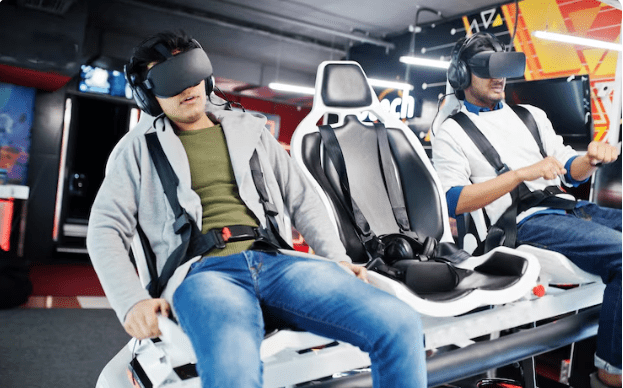
These days, there’s a good chance you’ll find one in any big mall in a mid-sized city: a collection of motion platforms bolted to the ground, each holding a seat and a pair of VR goggles, surrounded by a small group of people watching someone wearing a headset flinch at something only they can see. From the outside, the experience appears straightforward. You take a seat, the belt clicks, someone throws you a headset, and for three to five minutes you’re in a whole different place—flying a fighter jet, plunging from a building, or riding a virtual roller coaster through imaginary worlds. The next person enters after you climb out, looking a little pale.
More engineering and operational judgment is required between the sitting down and the climbing out than the setup indicates. VR thrill simulators are situated at the nexus of consumer electronics, electrical infrastructure, and amusement ride mechanics—three fields with distinct failure modes, safety cultures, and regulatory frameworks. The industry is still grappling with the practical difficulty of managing all three at once in a setting where the operators may be hourly workers who have completed a two-hour training session.
Because it has the most obvious effects, motion sickness—more accurately, cybersickness in the context of virtual reality—is the most obvious issue. The mechanism is a conflict between the visual system’s perception and the vestibular system’s perception. The brain interprets a significant discrepancy between the two inputs as possible poisoning and produces nausea as a defense mechanism. It’s a highly sophisticated technology triggering an old biological instinct. Frame rate, latency, the type of visual content, individual physiology, and how closely the physical platform movement matches the on-screen motion are some of the factors that determine the intensity. 40 to 70 percent of VR users report experiencing some degree of discomfort, ranging from mild uneasiness to severe nausea, according to numerous studies.
The majority of commercial headsets now demand a baseline frame rate of 90 frames per second or more; a frame rate below 72 frames per second dramatically increases symptom reports. Operators are effectively operating a disease machine when they allow their hardware or software to deteriorate below specified levels due to aggressive cost-cutting, antiquated equipment, or poor maintenance.
Although less evident, the restraint issue may have greater implications. VR users run the risk of falling or getting hurt on the platform’s mechanical parts if they become disoriented in the headset and attempt to stand up, or if they lose awareness of where their actual body is in relation to the platform. Physical disorientation is a realistic concern because of the immersive quality of the experience; users may lean into twists they cannot physically feel, grab for handrails they can see electronically that aren’t there, or attempt to move forward while the platform has moved. Commercial VR simulators must have restraint mechanisms that not only keep users in their seats during regular operation, but also prevent them from leaving at the incorrect time and enable a safe, supervised dismount when the headset is taken off and the user is reoriented to the real world. Harness locks, safety bars, and platform boundary sensors are examples of tasks that appear routine until one day they aren’t.
In a high-density commercial virtual reality setting, electrical safety presents a unique set of challenges that are sometimes overlooked. Conditions where cable management, grounding, and thermal management are all important are created by several motion platforms, each of which requires a substantial amount of power for the movement actuators, the heat produced by VR computer systems, and the heavy foot traffic of a large venue. Failure modes in this industry that have been identified include frayed wires, insufficient grounding of metal platform frames, and the proximity of high-voltage equipment to food and drink areas.
In well-managed venues, emergency power cutoffs—which operators can access in a matter of seconds and are not hidden behind a panel—are standard procedure; in a startling percentage of other venues, they are not. Many venues are piecing together their electrical safety strategy from consumer electronics standards, general electrical codes, and traditional amusement ride regulations that weren’t written with this kind of equipment in mind because there isn’t a single regulatory framework that specifically addresses VR simulators.
In some respects, the main problem is the regulatory gap. Conventional amusement ride standards, such as ASTM F2291 in the US and EN 13814 in Europe, offer frameworks for mechanical ride safety that have been improved over many years. VR simulators fall into a gray area since they are too physically dynamic and engaging to be classified as consumer electronics, yet they are not exactly like traditional rides where the mechanical risks are thoroughly documented and examined under established protocols. The majority of jurisdictions are currently determining which framework is appropriate. Operators, manufacturers, and venue owners are in charge of creating their own safety procedures in the interim using components of various current standards and any instructions supplied by the equipment makers.
