


Families who have made a sensible choice pack the parking lot at The Wave in Coventry on a gloomy Tuesday in August, the kind of day that, in the eyes of everyone who has ever booked an outdoor activity and watched the forecast deteriorate overnight, epitomizes the British summer. Inside are the slides. Inside is the wave pool. The roof doesn’t leak, and the temperature is regulated. Regardless of what the sky is doing outside, it is consistently warm and humid in a way that people have genuinely paid for.
After a £36 million investment that, looking back, appears to have been well-timed and well-considered, The Wave launched in Coventry. The desire for water park recreation has always existed in Britain, as seen by the long lines at outdoor parks on warm days, the popularity of swimming pools at vacation parks, and the propensity to travel to European locations with better weather in order to use this type of recreational equipment. The availability of genuine, purpose-built indoor facilities that completely eliminate the weather issue is what it has lacked. That gap is directly addressed by The Wave’s formula, which combines a wave pool, a lazy river, and high-speed slides like the 20-meter Speed Slide and The Navigator under one roof.
In order to comprehend why this investment model is successful in Britain, it is important to compare it to northern Europe rather than Florida or Queensland. For decades, Germany, the Netherlands, and Scandinavia have been constructing vast indoor water parks and running them economically all year round in regions that are arguably wetter and colder than England.
Every year, millions of people visit Tropical Islands outside of Berlin, a former airship hangar transformed into a 66,000 square meter indoor tropical environment that is completely independent of the outside weather. One of the biggest thermal water parks in Europe is Therme Erding in Bavaria, which operates in a climate that would keep an outdoor park closed for four months out of the year. After 20 years of witnessing this model’s success on the continent, Britain is only now starting to move toward it on a similar scale.
The more ambitious end of the future is represented by Therme Manchester. Conceived on a different scale than The Wave’s current locations, the £250 million planned facility is located approximately 90 minutes from Birmingham and is intended to service the heavily populated Northwest and Midlands region. The Therme Group’s approach, which is specifically intended to serve as a domestic substitute for international wellness tourism, mixes water slides and pools with thermal spa facilities and leisure activities focused on wellbeing in a climate-controlled tropical setting. Families with small children are not the only target audience. If the product were available, folks who would normally reserve a weekend in Budapest or Baden-Baden for the spa experience may be convinced to spend that money domestically.
These investments are now taking place on a significant scale due to the economic rationale of year-round indoor business. If it’s fortunate, an outdoor water park in Britain can make its yearly revenue during eight to twelve weeks of consistently warm weather, with shoulder-season weekends making up some of the difference. A large water park facility’s capital costs do not decrease in direct proportion to that operating window. Revenue from indoor facilities is distributed across the entire calendar, including the Christmas holidays, the half-term in February, Easter, and every rainy summer week that brings families to the beach in search of alternatives. Simply put, the financial model is more stable, and stable financial models draw investment.
The Wave Group’s strategy to grow throughout several UK cities—Bristol, Sheffield, and Coventry are currently operational, and more locations are being planned—reflects their belief that demand exists in several regional markets concurrently rather than just one. Every position increases brand awareness, which facilitates filling the subsequent one. The eventual inauguration of Therme Manchester will test if the premium end of the market—longer stay times, higher visitation costs, and spa-integrated experiences—has the same trajectory in Britain as it does in Germany and Austria.
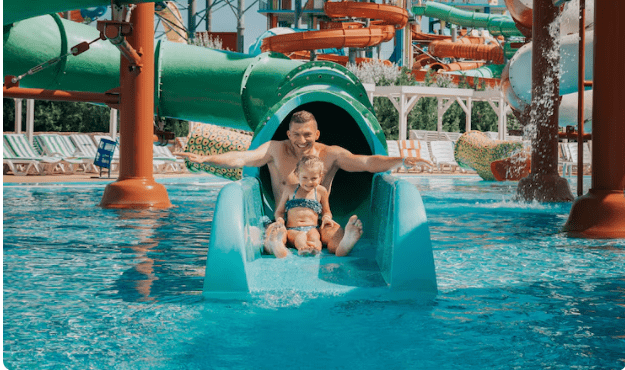
Seeing Britain’s indoor water park infrastructure finally reach the level of sophistication attained by other northern European nations a generation ago is a bit overdue. The weather hasn’t altered. There was always a demand. The availability of cash, operational concepts that have been demonstrated elsewhere, and a local leisure market that has expanded sufficiently to warrant significant investment at this scale are what have changed.
