


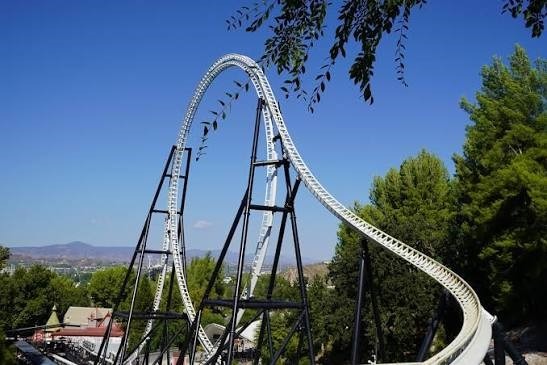
On a busy day in Valencia, the line for X2 at Six Flags Magic Mountain winds back a considerable distance. When a first-time visitor approaches the loading platform after a 45-minute wait and is prepared to board one of the world’s most thrilling roller coasters—a 4D free-fly coaster that rotates riders head-over-heels independently of the track—the last thing they expect is to be told they are unable to ride. Not due to height. Not due to a medical problem. due to the phone in their pocket, the fanny pack they wore especially to keep their hands free, or the bag dangling from their shoulder.
It frequently occurs. Although the park’s policy is clear and posted at ride gates, guests are frequently caught off guard by the discrepancy between what they read on the Six Flags website and what they really experience within the park, as evidenced by the fact that it appears in nearly every visitor review. Standard bags, purses, and backpacks can pass through security at the main gate without any problems. The ride platforms are a completely different story. No loose items of any kind are allowed in the line or at the loading station on X2, Tatsu, Full Throttle, West Coast Racers, and Twisted Colossus. This includes phones, keys, wallets, cameras, and fanny packs, which many guests wear because they believe small equals acceptable. Regardless of size, the answer is no on these rides.
It is worthwhile to explain the mechanics of why this is important at X2 in particular. The speed of the ride is 76 miles per hour. The circuit has full rotations, where riders are inverted and spinning, as well as vertical drops. The kinetic energy of a far heavier object dropped from a considerable height would be carried by a 200-gram phone traveling through that environment at a high speed if it were to break free. There would be dire repercussions if it were directed onto a mechanical part, another train, or a bystander beneath the ride. The 2021 Cedar Point incident, in which a bracket broke off from a train on the Top Thrill Dragster and hit a passenger in line, rekindled industry attention to the potential consequences of loose objects and structural elements when a ride is running above its design limitations. The fundamental physics of high-speed projectiles are the same, but that occurrence featured a mechanical failure rather than a personal object.
Ride-side lockers are placed right outside the entrance to each major attraction as part of Six Flags’ solution to this issue. Visitors who intend to ride several extreme coasters can purchase an all-day admission. Lockers are rented on a per-use basis, usually for two to three dollars per transfer. The all-day option makes the economics of a full-day visit considerably more realistic because it allows visitors to move their items between lockers throughout the park without having to pay each time. The park explicitly specifies in its conditions that items left unattended outside ride entrances be disposed away, so leaving a bag somewhere unofficial and hoping it would be there when you return is also not a viable choice.
The demand for lockers causes frequent tourist annoyance, which is evident in all theme park forums pertaining to Magic Mountain. Some visitors feel that the economics are harsh because you have to pay for entrance, stand in long lines, and then pay again to get on the ride. That grievance makes sense. Additionally, it is rather unrelated to the purpose of the policy. The park’s main business isn’t making money from lockers; rather, it’s handling a safety issue for which there isn’t a workable large-scale answer. Every rider’s pockets cannot be physically searched by staff. They are unable to confirm that a phone is fastened securely enough to withstand an inversion at a speed of more than 70 miles per hour. The variable is completely eliminated by the locker system.
The strictness of enforcement, not the policy itself, has altered in recent years throughout the Six Flags chain and at the majority of major US parks. The regulations pertaining to loose objects have been in place for many years. The propensity to halt a queue, stop loading, or turn riders away when a visitor tries to bring an item that is not allowed onto the platform has become more constant.
Similar restrictions have been placed on filming: GoPros, body cameras, and glasses with built-in lenses are all prohibited on any rides at Six Flags Magic Mountain, regardless of whether the equipment is mounted or handed. The 2024 incident, in which YouTuber Mark Rober was stopped mid-ride at Six Flags Great America and escorted out by security for recording, demonstrated that enforcement is now being applied more widely and less selectively than it was in the past, even though Rober was creating an instructional video rather than content intended to disrupt operations.
