


A high-speed camera, aimed at the base of a 400-foot drop tower and operating at 10,000 frames per second, records something that no inspector standing next to the building could see with their own eyes. The steel columns flex as the gondola slows down thru the magnetic braking zone, which is a controlled, contactless slowing that turns a free-falling compartment’s velocity into heat instead of collision. Not in a big way. Not in any way that would be considered a discernible movement. However, by tracking thousands of speckled points over the tower’s surface frame by frame, the image correlation program creates a picture of micro-deflection that provides engineers with crucial information about how these structures truly behave under the pressures they support.
For many years, the application of digital image correlation in structural engineering has been growing. A speckle pattern is applied to a surface, and the movement of each point in the pattern between successive high-speed frames is tracked. The result is a full-field map of deformation, which shows where the structure is concurrently bending, stretching, and concentrating stress across its whole visible surface rather of just one value from a strain gage at one spot. This method has been used in lab settings to investigate everything from aircraft fuselage loading to bridge deck fatigue. It has only recently been applied to amusement ride structures, and it is revealing dynamic behavior that was not intended to be captured by earlier inspection techniques.
Once explained, the physics behind why mega-drop towers flex when braking is quite simple. By putting a conductive substance via a magnetic field, eddy-current braking creates opposing electrical currents that resist motion. Modern drop towers stop without the shock of mechanical friction brakes because the technology is smooth and frictionless. However, “without dynamic loading” at the structural level does not equate to “smooth” at the passenger experience level. The vertical columns, which are tall, slender, secured at the base and at intermediate bracing points, bend in response to the opposing force applied during deceleration thru the gondola’s guide system. It has a tiny amplitude. When engineers consider fatigue across tens of thousands of working cycles over several seasons, what matters are the frequency and the sites where stress collects.
The focus is mostly on the weld zones. Contrary to what a static analysis might imply, structural steel columns do not break due to simple elongation or compression. At points of stress concentration, such as where components meet, where shape abruptly changes, or where loads shift between parts, they acquire fatigue damage. That type of place is the connection between a vertical column and a horizontal bracing element, and it’s the kind where a measurement method that merely provides a point reading can fail to capture the entire picture. In order to determine where stresses are concentrated most intensely and where micro-crack initiation is most likely if loading persists over time, DIC maps the whole joint region.
The August 2025 Cedar Point Power Tower incident, in which a cable snapped audibly and left riders stranded at an elevation before they were manually lowered, brought amusement ride towers’ structural alterations between visual inspection windows back into the spotlight. Although the event was caused by a cable failure rather than a column flexing problem, the fundamental question it posed is the same one that high-speed optical monitoring is intended to answer: what is going on in the structure during operation that isn’t being picked up by routine static inspection? When a cable experiences frequent dynamic loads and develops micro-fatigue at a connection point, it may not exhibit any visible signs of distress until the load cycle that causes failure. Weld zones in column constructions under cyclic braking stresses are subject to the same principle.
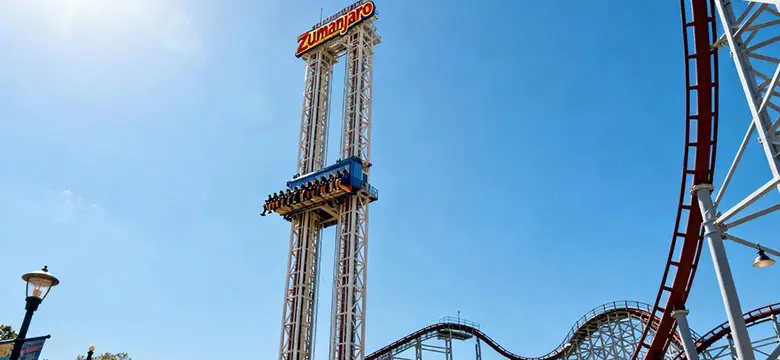
The before-and-after capability that DIC and high-speed photography provide alters the discourse. Because ASTM F2291 mandates structural analysis that include dynamic loading scenarios and responsible manufacturers incorporate deceleration forces into their column sizing and bracing specifications, engineers constructing mega-drop towers already take dynamic loads into account in their calculations. There are design tolerances. Optical measurement offers empirical validation that a built structure’s actual behavior under operational stress is consistent with the design model’s predictions, as well as the ability to identify any areas where the real-world response deviates from the analytical assumption. When there is a divergence, the danger is concentrated there.
