


The Supergirl Sky Flight at Six Flags Fiesta Texas was performing its intended function on a Sunday afternoon in San Antonio: raising passengers in open chairs. When an operator at the ground control station noticed something, they were spinning 200 feet above the park’s limestone quarry setting at a speed that made the park’s official description, “too bad you’ll be spinning too fast to catch more than a blur,” feel true. One of the visitors had taken out a phone. As required by protocol, the operator stopped the trip. at its height.
Depending on whose narrative you trust more, the wait for all the riders, suspended in open chairs at about the height of a 20-story building, lasted anywhere from seven to fifteen minutes. They descended without incident. The ride was reopened. And one of the most popular amusement park videos of the spring was the one Maria Salazar took from her chair, showing the other riders sitting silently in the air over San Antonio while she briefly laughed.
It makes sense to read this as a tale about a broken ride. The video seemed frightening. It had the visual syntax of an equipment breakdown, with riders dangling at a height with no apparent motion and the park spread out beneath them. Eventually, maintenance phoned to bring the ride down instead of allowing it to finish its cycle properly. However, the official statement from Six Flags and the inspection records present a different picture: this was a safety stop that was functioning properly due to a human breach of a policy that is in place for simple physics reasons.
Before landing, a six-ounce phone dropped from 200 feet travels about 75 miles per hour. There is a potential impact zone for those who are walking beneath the ride’s footprint. Cellphone prohibitions on high-altitude swing rides are an extension of the same reasoning that mandates the use of helmets on roller coasters and height restrictions for particular attractions; they are not theme park theater. From 200 feet above the ground, the operator noticed a visitor getting ready to record the ride and made the call that the manual instructed.
The chronological disparity is what makes the occurrence require closer examination than a typical viral moment. According to Six Flags, the standstill took about seven minutes. Salazar and other riders said they had to wait ten to fifteen minutes for maintenance to come out and manually lower them. Both statements may be partially accurate; for example, the policy infraction might have been fixed in seven minutes, but the ride’s mechanical descent from its highest point took longer.
However, even though the difference is small in absolute terms, it accurately captures the riders‘ real experience: they weren’t sitting at 200 feet for seven minutes. Until maintenance showed there, at whatever time, they were seated at 200 feet. Because the starflyer design is built to stop and hold at elevation rather than release tension in an uncontrollable manner, the ride’s emergency stop system kept them there. It is possible to be both correct and uncomfortable at the same time.
The broader context is also important. In the same week, a roller coaster at Six Flags New England in Agawam, Massachusetts, abruptly stopped, causing riders to be evacuated from Superman the Ride. This incident likewise involved a guest’s cellphone, but it was addressed without any injuries and resulted in news coverage and video.
A question about behavioral enforcement rather than mechanical safety is raised when two occurrences involving the same rule occur within days of one another in the portfolio of the same theme park firm. The policies are posted in the parks. They are enforced by the ride operators. Sometimes the guests disregard them, either because they are not aware of the particular risk or because they believe the photo is worth the trouble to everyone else in their row. From the receiving end, enforcement appears like a seven to fifteen minute wait at 200 feet.
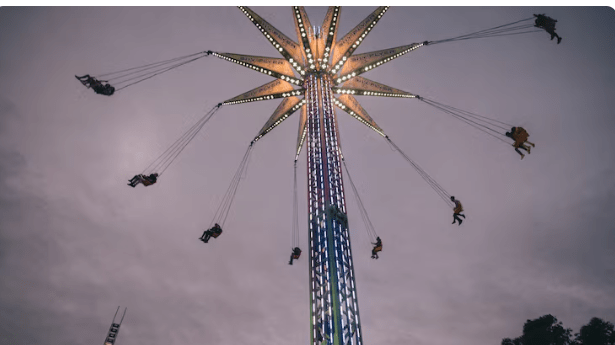
There is something genuinely illuminating about the scene in the video that went viral from Salazar’s phone: riders sitting silently in their chairs, the park spread out beneath them, and the tranquility of a ride that stopped because it was intended to, with no signs of technical difficulty. Every year, rides are inspected by the Texas Department of Insurance. Every day, Six Flags conducts pre-opening inspections. On April 26, 2026, the Supergirl Sky Flight was successful.
To the extent that they are available, the inspection records demonstrate a well-maintained ride functioning within the constraints of its design. They fail to take into consideration the particular type of unease that arises from waiting in an open chair at the top of a twenty-story structure while someone on the ground determines which rider took out their phone. The safety mechanism at the park was effective. The headline is accurate. It simply doesn’t convey the true experience of sitting at 200 feet for fifteen minutes.
