

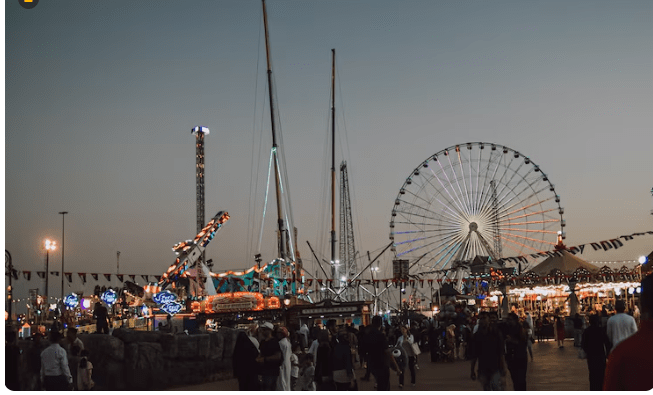
Seasonal funfairs arrive in Northern Ireland’s towns and villages every year in the same manner that they have for generations: a field or parking lot that was empty the day before, a convoy of lorries, and a collection of spinning, swinging, and quickly rotating machinery assembled and made public within a day or two. The business model includes the transition’s speed. From the standpoint of a safety regulator, it’s also the area that needs the most care.
The seasonal funfair industry is beginning to accept the gravity of the Health and Safety Executive for Northern Ireland’s increased oversight. The rules themselves are straightforward: before the public is permitted to ride any ride, it must be thoroughly tested, appropriately designed, and safely installed. There needs to be independent engineering certification. Employees using high-speed machinery must have official training that can be verified, not just experience gained on the job. These are the guidelines. When significant malfunctions or safety violations have occurred, HSENI has made it clear that it will pursue prosecutions when the standards are not met, and it has done so by bringing operators and independent engineers to court.
Compared to permanent theme parks, the funfair industry occupies a unique regulatory area. A fixed park, such as Tayto Park or Alton Towers, features rides that remain in place, year-round maintenance crews, and infrastructure designed specifically for that purpose. After every engagement, a traveling funfair operator disassembles the equipment, moves it while traveling, and reassembles it somewhere else—sometimes within a week, sometimes faster. Repetitive assembly and disassembly result in actual, cumulative mechanical strains. The risks associated with incorrectly constructed temporary rides differ from those at permanent facilities, and independent engineers are responsible for certifying equipment in less controlled and occasionally poorly lit environments than an indoor maintenance facility.
The aspect of this that receives less public attention than the technical standards but is just as important in practice is staff training. A true safety asset is a ride attendant who is knowledgeable about the equipment they are using, including how to handle a line of eager kids and anxious parents without putting undue pressure on them to keep the ride running when something feels off. No matter how safe the ride is, an attendant who received thirty minutes of training prior to their first shift is not. In an effort to close that gap with something more substantial than well-meaning intentions, HSENI requires companies to provide formal training for all attendants.
Because Northern Ireland’s funfair safety regulations are governed by HSENI rather than the mainland HSE, the enforcement culture and priorities may differ from those that operators may encounter in England or Wales. Operators that presume a uniform approach throughout the UK while traveling between jurisdictions are finding that this assumption is untrue. HSENI’s readiness to prosecute serves as a means of communicating to the industry that compliance is mandatory and that the investigation process that follows a malfunction will closely examine whether the pre-opening standards were fulfilled.
Why this type of regulatory attention tends to escalate when it does is worth noting. Like other safety sectors, entertainment regulation generally follows a reactive pattern: a significant occurrence or a string of near-misses triggers a reassessment of whether current standards are sufficient and whether enforcement has been consistent. According to Northern Ireland’s current strategy, a review is in progress. The direction of travel is clear, but HSENI doesn’t always share detailed information about whether it’s fully proactive or partially a reaction to certain instances. Northern Ireland’s seasonal funfair business is under closer scrutiny than it has ever been, and its operators are aware of this.
