

A consumer drone records footage that no Disney camera crew has approved somewhere over the Magic Kingdom on a Saturday afternoon in the summer. The under-construction attraction is suddenly visible in 4K, only months away from a public presentation with its own meticulously planned announcement campaign. The video has received 100,000 views on YouTube by Sunday morning. The marketing team is holding a different type of meeting on Monday than what was originally scheduled.
This is not a hypothetical situation. The FAA, the Department of Homeland Security, several congressional committees, and the legal departments of some of the biggest entertainment companies in the world are all involved in the policy debate that began as a niche aviation issue and has since spread to major parks across the United States.
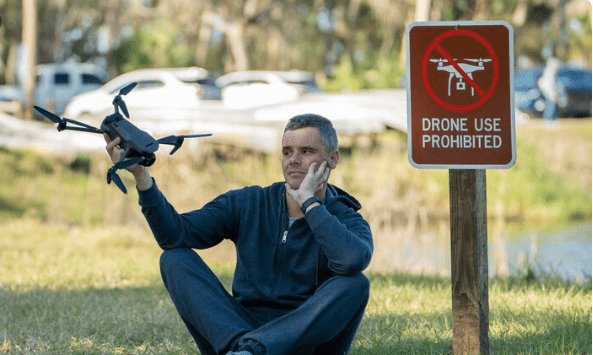
The operation of American airspace is where the basic issue begins. A theme park’s property border terminates at grade, but its airspace does not belong to it in any significant regulatory sense because the FAA controls anything above ground level in the US. Through established federal procedures, military locations, airports, and some stadiums are officially designated as no-fly zones. Commercial theme parks lacked a comparable route until recently. Technically, an unapproved drone flying over a roller coaster was in violation of FAA rules regarding crowd proximity, but the parks themselves lacked the legal means to stop it and a specific process for requesting permanent protected status.
That was altered, at least in part, by Section 2209 of the FAA Reauthorization Act and later rulemaking under the Safer Skies Act. Amusement parks and other fixed-site facilities can now request for designated airspace limits through a formal petition process established by the legislation. Parks is currently actively going through that process, but the regulations are still being developed, the petition deadlines are lengthy, and the more general issue of enforcement is still unsolved. Being aware that a drone is in restricted airspace does not equate to being able to take immediate action.
The debate over counter-UAS technology begins at that point. Counter-drone systems exist and function rather effectively in controlled environments. These systems are capable of detecting, tracking, jamming, or physically intercepting unmanned aircraft. Currently, airports and federal agencies are permitted to use them under certain conditions. Much more contentious is the issue of whether theme parks or state and local law enforcement should be allowed to use them. The wider radio frequency environment is impacted when a drone’s radio signal is jammed, potentially interfering with other devices. There are additional safety dangers when a drone is physically brought down over a busy park. Furthermore, extending these powers raises Fourth Amendment concerns about privacy and surveillance that the safety argument does not directly address.
Although the specifics are actually unclear, there is a sense that this policy area is heading toward the possibility of some kind of increased autonomy for parks. Although legitimate, the IP protection argument is not the best one to use as a starting point in a policy discussion. The safety argument—drones landing in pyrotechnic zones, colliding with rides, and falling onto crowds—is simpler and more difficult to refute. Instead of defending an undisclosed ride reveal, major parks have been basing their case on safety data, which is a more sympathetic framing for legislative reasons.
The fact that Disney and Universal use the same technology that parks want prohibited for illegal users for their own aerial entertainment—the synchronized drone light shows that have become a mainstay at significant park events—makes the matter truly complex. Any straightforward ban is complicated by the fact that the distinction between a drone as a threat and a drone as a productive instrument passes through the same airspace. Both variants of the same vehicle must be covered by the regulatory framework that is being developed around this. Washington is still working on that issue, which is more difficult than it first seems.
