


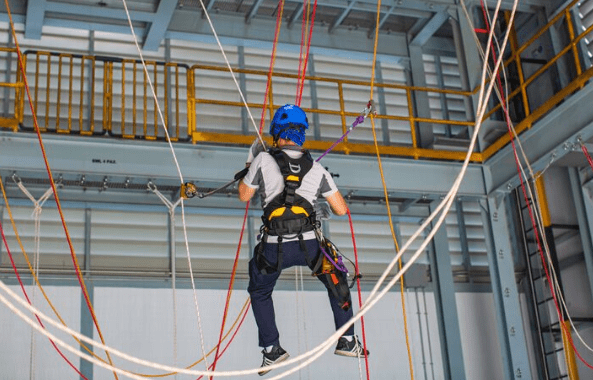
On a Thursday morning in early spring, a technician in a harness is gently moving along a suspended line at the top of an aerial ropes course while holding a small device against the wire. Fifty feet of empty air lies below. Ten meters behind her is the platform from whence she began. She is examining a cable that has supported participants’ weight during operation for an entire season, including summer humidity, fall precipitation, and any freeze-thaw conditions brought on by the winter. Today, no one is going to climb up here for fun. She arrived first.
Compared to the majority of other outdoor recreational facilities, suspended ropes courses pose a unique inspection problem. Wire ropes supporting walkways, linking platforms, and anchoring safety lines are among the components performing vital safety duties that are subjected to situations that accelerate wear in numerous directions at once. The outside wire strands are abraded by friction from the hardware that clips onto them when they are in use. Rain and surrounding moisture encourage rust on the exterior and, more problematically, inside the core, where it is invisible without specialized tools. Over thousands of participant cycles, the mechanical stress from repetitive loading and bending builds up in ways that eventually weaken the cable without any one major incident signaling it. Even a seemingly sufficient cable may be carrying much less than its specified capacity.
Although visual inspection is the first step and is still the most common approach, skilled inspectors are not ashamed to admit its limits. Obvious issues like evident broken wires, surface rust, deformation, or flat patches from heavy loading can be found by walking a cable and looking at the outer strands. An instant replacement trigger is any significant number of broken wires in a brief span; the precise threshold varies depending on cable diameter and standard, but the general idea is the same. The cable drops. It is not put back into service. However, some of the most severe degeneration in wire ropes starts internally before it is apparent on the surface, and eye inspection is unable to see through the outer wires to the interior core.
That gap is filled by electromagnetic testing. Along the cable, magnetic flux leakage sensors look for irregularities in the magnetic field that could be signs of interior corrosion or broken wires, which would not be noticeable until the damage had advanced considerably. This technique originates from the mining and wire rope industries, where investment in detecting equipment is well-established and cable failure has serious repercussions. Operators of aerial ropes courses with well-established maintenance plans are increasingly using it as a recurring addition to visual inspection, especially for cables in high-use locations or those exhibiting any surface indication of impending issues. The information it provides is qualitatively different from what a visual check can provide, even though the device is not very large and the procedure is not very time-consuming.
The analysis gains a third dimension from tension testing. When compared to its rated draw force, a cable under operating load should report within a specified range. Internal deterioration, core degradation, or cumulative fatigue that has lowered the cable’s effective load-bearing capacity below specification are examples of structural integrity loss that can occur in a cable with low measurements without any obvious symptoms. It takes minutes to complete the test. The outcome either verifies that the cable is functioning as intended or indicates that a part needs to be changed before anyone attaches their safety system to it.
All of this is accompanied by a record-keeping need that is not an administrative formality. An accountability trail that benefits operators, insurers, and regulators is created when each cable has a documented inspection history that includes dates, findings, repair actions, and the name of the person carrying out the job. Additionally, rather than using generic timetables, it develops a useful tool for forecasting replacement intervals based on real usage and condition data.
On a busy outdoor course, high-use lines may need to be replaced much sooner than the manufacturer’s general lifespan recommendation recommends. By combining usage information with inspection findings, operators may make that determination using recorded facts rather than conjecture. Since the maintenance record is the only link between what is known about a cable’s past and the choice regarding its future, it seems to be as much of a safety asset as the equipment itself when examining the best-run operations.
